
The Oregon Critter & Travel Co.
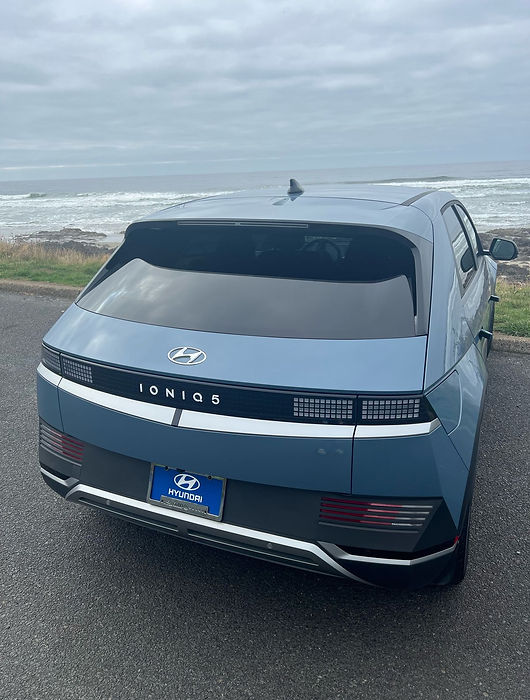
Our Hyundai Ioniq 5 at the Oregon coast. It's one of the quickest-charging cars on the road (about 18 minutes from 10–80% on a 350 kW charger).
DC Fast Charging: The Road-Trip Pit Stop
Coffee, restroom, 80%, go.
TL;DR: DC fast chargers skip your car's onboard charger and feed the battery directly. Most modern EVs go 10% → 80% in about 20–45 minutes. Unplug at 80%, because the last stretch is slow and holds up the line.
What "DC fast" means
Your battery stores DC power, but the grid supplies AC. At Level 1 and 2, the car converts AC to DC itself, slowly. A DC fast charger does the conversion inside that big roadside cabinet and pushes 50 to 350+ kW straight into the battery. The Department of Energy puts it at roughly 100–200+ miles of range in 30 minutes, depending on the car. (People also call it "Level 3.")
The three plugs
-
CCS1 ("Combo"): Most non-Tesla EVs through about 2024, including our Ioniq 5, EV6, Bolt and MINI
-
NACS / SAE J3400: Every Tesla, plus many 2025+ EVs (for example the 2025 Ioniq 5 and 2025 EV6)
-
CHAdeMO: Older Nissan Leafs and a few other older cars. Being phased out.
The big networks
-
Tesla Supercharger: the largest network, now open to many non-Teslas. How that works →
-
Electrify America: CCS, up to 350 kW, often at Walmart and shopping centers.
-
EVgo: CCS (some NACS), often at grocery stores and Pilot/Flying J travel centers.
-
bp pulse, ChargePoint, IONNA and others are filling in gaps.
The 80% rule
Charging is fastest when the battery is low and slows way down past about 80%, which protects the battery. Two short stops at 10→80% usually beat one long stop to 100%. Unplugging at 80% is also good manners when people are waiting. Many networks charge idle fees if you stay plugged in after you're done.
Which cars can DC fast charge?
Nearly every modern EV, including every car in our fleet. Some older or budget EVs and most plug-in hybrids can't. Check for the extra pins under the J1772 plug (CCS) or a NACS port.
Quick tips
-
Precondition. Set the charger as your destination in the car's navigation so it warms the battery on the way. This matters a lot on cold Willamette Valley mornings.
-
Check the app first to see live stall status and price. Salem fast-charging prices were about $0.33–$0.64 per kWh in early October 2026, depending on network and time of day.
-
Always have a backup station in mind.
Handy gear
-
Lectron CCS1-to-NACS DC Adapter (UL 2252): For Teslas and NACS-port EVs that want to fast-charge at CCS stations like Electrify America and EVgo. Teslas need "CCS Adapter Support: Enabled" in their software info.
Want to try an EV before you buy? Rent an EV from ORCritters on Turo. We're veteran-owned and Salem-based, with Salem airport delivery available.
← Back to the guide: Charging Made Simple
Next up: Why Some Cars Charge Faster Than Others
As an Amazon Associate we earn from qualifying purchases.